
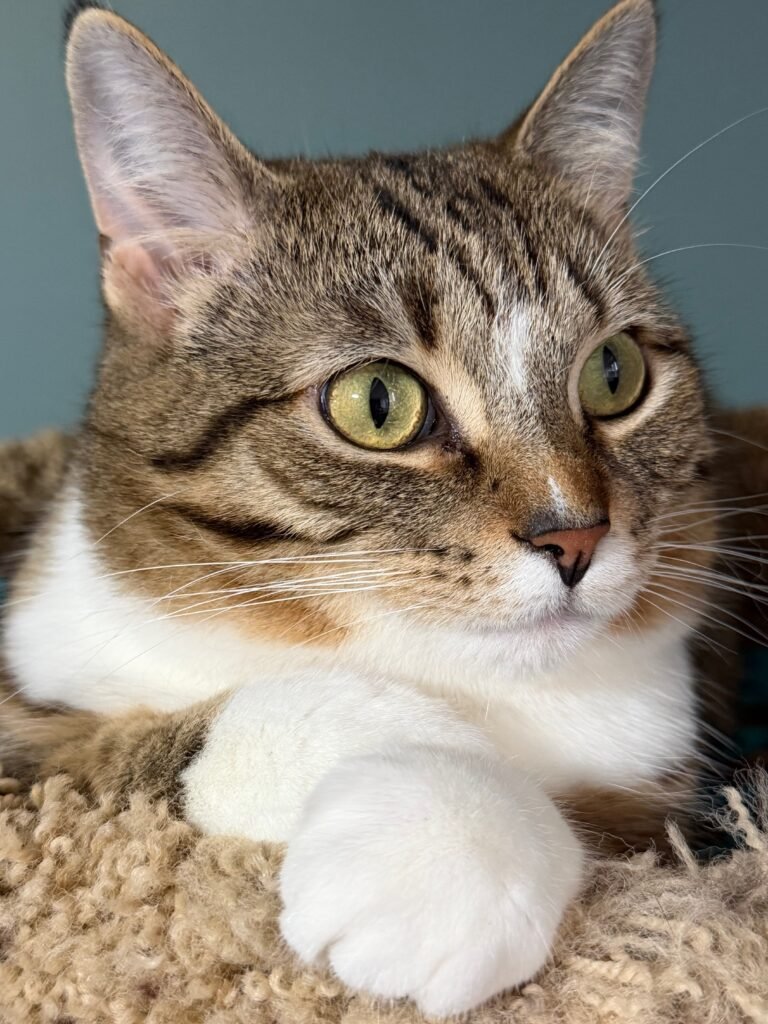
1. Kneading
Kneading is an instinctual behaviour. Kittens know to knead from birth because the action stimulates their mother’s flow of milk while nursing. But cats may knead long after they’ve been weaned, and not just because it’s an inherently self-soothing behaviour associated with comfort. It’s a way to leave their scent behind, stretch their muscles, and prep their bed for sleepy time. If your cat is kneading, it’s a good thing. Consider all the charming nicknames humans have created as a result: making biscuits, rolling the dough, happy hands, etc.
2. Purring
Purring, loudly or quietly, can be a sign of happiness or a sign of stress. Cats will purr when content and feeling well loved. If kitty is uncomfortable, they may be purring to self-sooth and release endorphins. If you’re unsure of why your cat is purring, consider the situation they’re in and what other behaviours they’re exhibiting. Are their ears swept back? Are their eyes dilated? Are they consistently licking their lips? These and other actions could indicate your cat is purring to keep calm.
3. Slow Blinking
A cat that not only blinks slowly, but closes their eyes around you, is a massive sign of trust. In the feline world, if they close their eyes, they are vulnerable. By slowly closing their eyes, your cat is indicating that they feel safe in your presence. Recent studies also suggest that cats recognize our intention when we slowly blink back in response!
On the flip side, if a cat is frightened or shy, try avoiding eye contact altogether. If kitty is not comfortable, staring can be a read as a threat.
4. Head Butting
Cats that head butt are likely marking you with their scent as a form of affection. Humans usually pet and snuggle a head butting cat in response. However, a cat may head butt without wanting to be touched back. Consider the cat’s other behaviours, environment, and personality. This logic also applies to cats who lay on their backs – they feel safe, but they may not want you to go right in for a belly rub.
5. Vocalizing
Cats talk! Be it a meow, chitter, or trill. Different vocalizations can mean different things. That said, most of the noises your cat makes that aren’t growls, hisses, or yowls are good signs. Chittering or chirping, for example, is often a way to convey excitement, especially if they see a bird outside. Trilling, which sounds like a meow and a purr at the same time, is a noise often associated with playtime happiness. And while cats do vocalize to communicate with humans, they do so with other cats as well. A mommy cat may meow to coax her kittens over to nurse. Kittens may trill and purr to ask another cat to play or to signal to their mother they need something from her. Just like people, cats use their voices for all sorts of communication.
6. Scratching
While humans find scratching to sometimes be a challenging behaviour to deal with, it is vital that cats be allowed to scratch. Much like kneading, scratching can be a form of scent marking and stretching muscles, but scratching is also a way to maintain healthy claws. A cat’s nail will shed its outer-most layer every few months. Scratching helps to remove loose sheddings and keep them from getting lodged in their fur or skin. Scratching also keeps their claws sharp, which is important for climbing, balance, traction, and in worst case scenarios, self-defense.
7. Zoomies
Zoomies are described as sudden bursts of energy. Scientists call this FRAPs: Frenetic Random Activity Periods. But zoomies aren’t as random as they seem. Cats often engage in zoomies as a way to release pent-up energy, as a way to satisfy their inner hunting instincts, or just because they had a good poop!
Let’s get more specific on these three considerations. First, indoor cats may have less opportunities to exercise, so zoomies help let off some steam. This is a good thing too – these bursts of energy help your cat’s muscles and cardiovascular capabilities. Second, cats are crepuscular, not nocturnal. This means they are most active at dawn and dusk, a.k.a. prime time to catch sleepy prey. If your cat is going bonkers first thing in the morning or when you’re winding down for the evening, this may be why. Lastly, cats can stimulate the vagus nerve when they use the litter box. This nerve runs from the brain all the way down to the top of the bum, and can be squeezed during a bowel movement. As a result, the nervous system comes alive and releases a large amount of energy into the body.
8. Hiding
While hiding is often a sign of fear or discomfort, sometimes your cat may just want to be left alone. Much like how humans may need a nap or some quiet time after a really stimulating experience, cats need their own time to recharge.
9. Biting
Cats use their mouths and teeth to interact with the world around them, especially kittens. They may be teething or simply nibbling at a toy during play time, which is a habit you can positively redirect toward cat-safe toys (keeping your fingers and toes intact). However, outside of these scenarios, biting is likely a way for your cat to communicate that a hard boundary has been crossed. They may be overstimulated, scared, stressed, or frustrated, and we humans didn’t recognize that sooner. More often than not, biting in these situations will be preceded by other forms of cautionary body language, such as tucked tail, flat ears, hissing, and lip licking.