
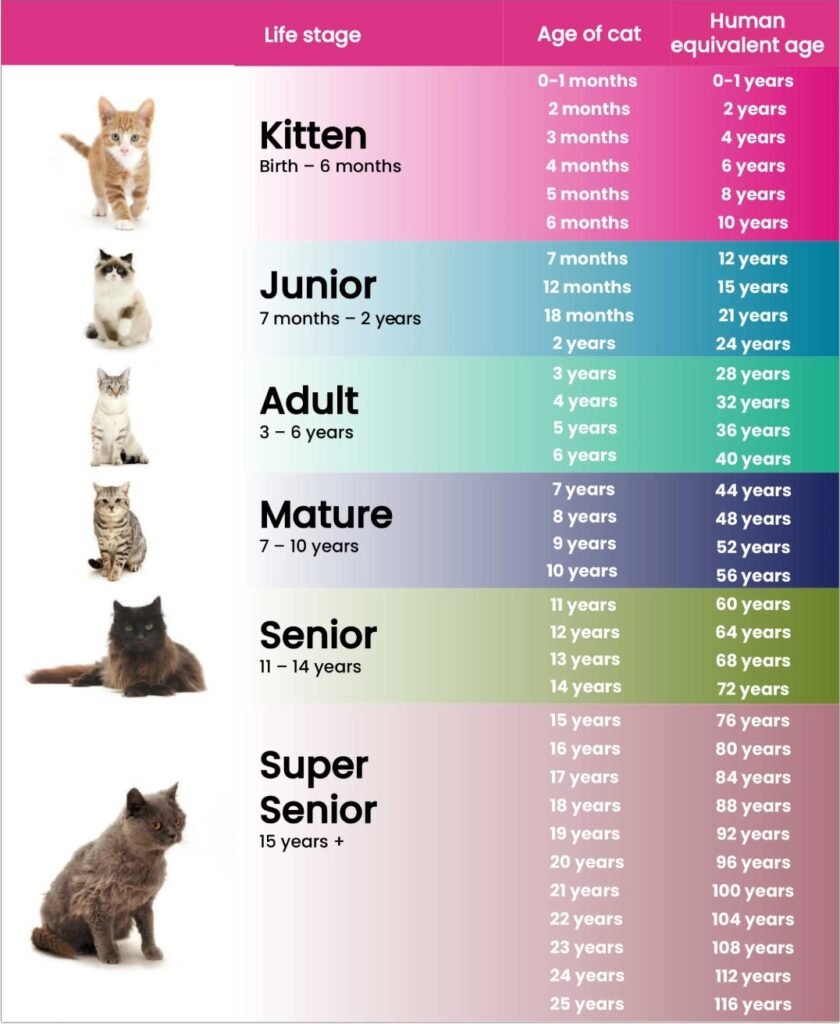
The image shown above is meant to help you understand “cat years” and the life stages a cat experiences in more human terms. With this information in mind, let’s take a look at how long cats of different ages can safely be left without human supervision.
Bear in mind that a kitten or cat with special needs such as cerebellar hypoplasia (CH), missing limbs, blindness, epilepsy, etc. may have different capacities for alone time.
Kittens
- Between the ages of 0 and 4 months, kittens typically cannot be left alone without their humans for more than 2 to 4 hours. Presence of the kitten’s mother, however, is important in determining if you can safely be away for more than 2 hours. This is because kittens under 2 months of age that are being bottle fed (and don’t have a mother to help care for them) have to be fed every two hours, night or day.
- Between the ages of 4 and 6 months, kittens typically shouldn’t be left alone for more than 4 to 6 hours. At this age, litter boxes can fill up faster due to just how quickly kittens metabolize and digest. They are also very active – between bursts of playful energy and a natural curiosity, you’ll want to keep tabs on what areas your kittens are getting in to and if they’ve moved anything around in their own space.
Juniors
- Between the ages of 6 and 12 months, juniors become more independent. As they approach 1 year old, cats can be left alone during your typical work day of 8 hours. This will vary depending on the cat. Much like kittens, juniors will have a ton of energy to burn and it’s important to know if they’ll be able to gain access to dangerous spaces or items you’d otherwise want them to stay away from.
Adults and Mature Cats
- Between the ages of 1 and 10 years old, cats are typically self-sufficient and can be left by themselves for no more than 24 hours. If their human goes on a day trip, they’ll usually be safe. However, anything beyond a day requires a check-in to ensure their space is still safe, their litter boxes are clean, they haven’t run out of food, etc. Cats are also social creatures! They’ll miss their humans.
Seniors and Super Seniors
- Above the age of 10, cats may start to calm down and their metabolic functioning slows. This means having to keep a closer eye on their needs. As such, it’s important not to leave them alone after 12-18 hours, depending on their activity level and health.
- For super seniors older than 15, it becomes critical to ensure they’re safe while alone, as they may not have the self-sufficiency they used to have. Be mindful of the signs your cat gives you to determine how long they can be on their own.